

Aluminium Scaffold for Industrial Maintenance: An Application-Based Case Study
Industrial maintenance often requires temporary access to areas that are difficult to reach from the floor. The challenge is not always simply getting higher. In many workplaces, the access equipment also has to fit through restricted areas, provide enough room for the work, allow workers to reach the required position comfortably and be practical to move when the job changes location.
This application-based case study looks at how a mobile aluminium scaffold tower can be selected for that type of work. The scenario is illustrative rather than a report of a specific customer installation. It is based on the types of access requirements for which Apexz Access Equipments’ mobile aluminium scaffold configurations are designed.
The Access Problem
Imagine a maintenance team working inside a large industrial facility. The team needs to carry out inspection, repair and installation work at elevated levels. The work is not limited to one point. During the maintenance period, workers may need to move between different sections of the facility as individual tasks are completed.
A fixed access structure would not necessarily be the most practical option for this type of work. The maintenance team needs a working platform that can be configured for the required height and, where the site conditions permit, repositioned between work areas.
Space is another consideration. Industrial facilities can contain machinery, storage areas, structural columns, pipework, production equipment and other obstacles. A scaffold tower that is too wide may be difficult to position in some areas, while a very compact platform may not provide enough working space for the task.
This is where selecting the right scaffold configuration becomes important.
Why Aluminium Was Considered
For applications where access equipment has to be assembled, handled and repositioned, aluminium can be a practical material choice. Its relatively low weight compared with many traditional structural materials can make handling and transportation more convenient, while the equipment still needs to be selected according to its rated capacity, dimensions, configuration and intended use.
The material itself is only one part of the decision. A suitable scaffold must also provide the working height, platform arrangement, access method and stability features required for the particular application.
For this reason, the selection process should start with the work rather than simply starting with a product name.
Understanding the Working Area
The first step in this type of application is to look at the actual working environment.
The maintenance team would need to consider the available floor area, access routes, doorway and corridor dimensions, overhead clearance, floor condition and the location of nearby equipment. They would also need to determine whether the scaffold would remain in one position or whether it would need to be repositioned during the work.
A narrow access area can make a compact scaffold configuration more practical. Where additional working space is available, a wider tower may provide a more suitable platform arrangement.
This is why a single scaffold configuration does not necessarily work for every industrial application.
Choosing a Narrow Mobile Scaffold Tower
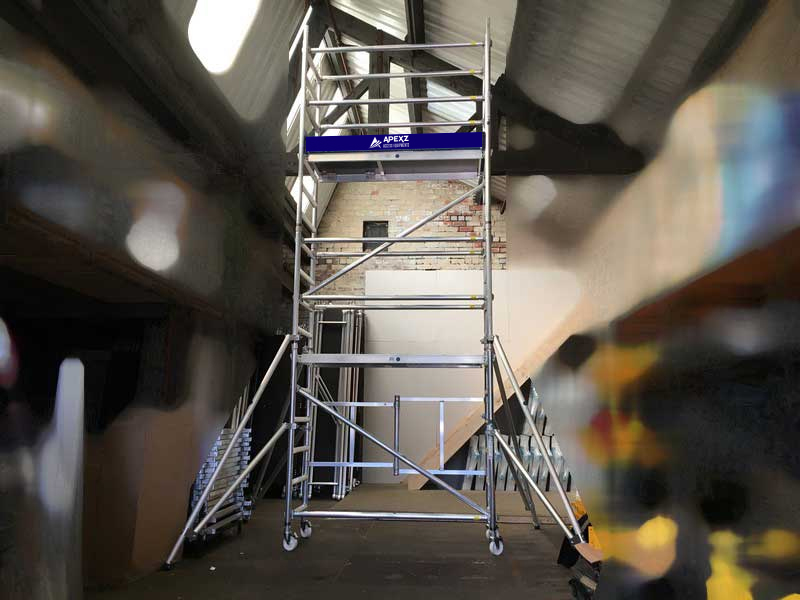
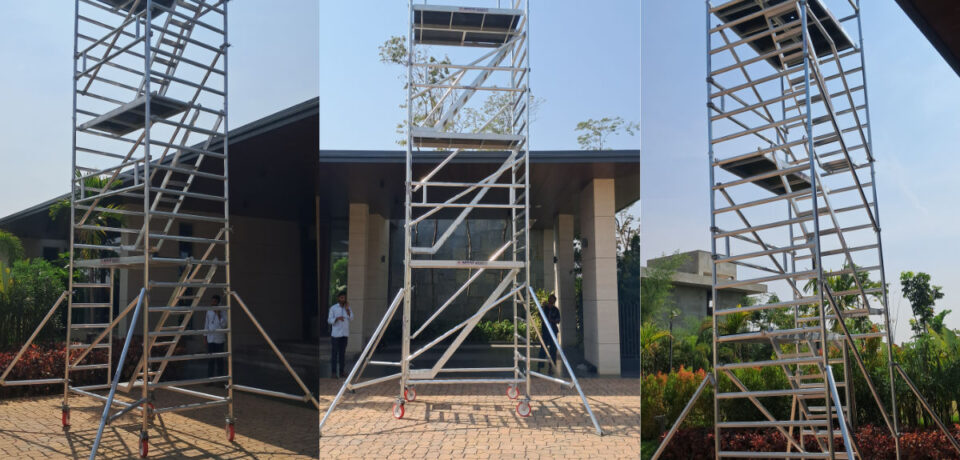
For a restricted working area, the narrow Apexz mobile aluminium scaffold tower with stabilizers can be considered.
The current Apexz product is designed around a 0.75 metre scaffold width, with available lengths of 1.80 metres, 2.50 metres and 3.00 metres. The product information states that working heights can be configured from 4.50 metres to 13.45 metres using standard parts, while platform heights in fully enclosed spaces are limited to 11.45 metres. The listed loading capacity is 200 kg/m², with the actual allowable load depending on the platform configuration.
For an illustrative maintenance application, the main advantage of this configuration is not simply its height. The narrower arrangement can be considered where available floor space is limited and the maintenance team still needs a proper elevated working platform.
The exact configuration would need to be selected according to the site, required working height, platform requirements and the manufacturer’s instructions.
When a Wider Scaffold Makes More Sense
Now consider a different part of the same type of facility.
There may be enough floor space available, but the maintenance task requires more room on the working platform. Workers may need to position tools and equipment around the work area, or the task may involve more movement across the platform.
In that situation, the wider Apexz configuration may be more appropriate.
The current wide mobile aluminium scaffold tower has a 1.35 metre scaffold width and is available with platform lengths of 1.80 metres, 2.50 metres and 3.00 metres. Apexz lists working heights from 4.50 metres to 13.45 metres using standard parts and a 200 kg/m² loading capacity, with the actual capacity depending on the platform configuration.
The wider arrangement gives the user a different working-space option. It should not automatically be considered “better” than a narrow tower. The correct choice depends on the application.
That distinction is important when selecting industrial access equipment.
When Stairway Access Becomes Important
There is another situation that changes the decision.
Suppose the work requires workers to move between ground level and the working platform repeatedly throughout the day. In that situation, the access method becomes an important part of the equipment selection.
A scaffold tower with an integrated stairway provides a different arrangement from a tower primarily intended around ladder access.
The Apexz mobile aluminium scaffold tower with stairway has a 1.35 metre wide structure and is available with 1.80 metre and 2.50 metre lengths. Apexz lists working heights from 4.5 metres to 12.35 metres with standard parts. The product also incorporates a wide entry-frame stairway with 100 mm deep non-slip tread surfaces.
This configuration can be considered for applications involving frequent climbing and descent, particularly where workers regularly need to move between the ground and an elevated working platform.
Again, the choice should be based on the work rather than the assumption that a stairway configuration is automatically suitable for every project.
Comparing the Three Configurations
The three configurations illustrate why access equipment selection should begin with the application.
| Application consideration | Narrow tower | Wide tower | Stairway tower |
|---|---|---|---|
| Restricted working area | Strong consideration | May require more space | May require more space |
| Additional platform space | More limited | Strong consideration | Strong consideration |
| Frequent climbing and descent | Depends on access arrangement | Depends on access arrangement | Strong consideration |
| Mobile industrial maintenance | Suitable consideration | Suitable consideration | Suitable consideration |
| Construction and installation | Suitable consideration | Suitable consideration | Suitable consideration |
| Working at different locations | Suitable where site conditions permit | Suitable where site conditions permit | Suitable where site conditions permit |
This table is not intended to replace a site assessment. It simply demonstrates how different configurations can address different working requirements.
The Importance of Stabilization
For a mobile scaffold tower, stability is a fundamental consideration.
The narrow and wide Apexz configurations incorporate stabilizers as part of their design. The manufacturer’s information should always be followed for assembly, positioning, use and any required stabilization arrangements.
A scaffold should never be modified with improvised components simply because a particular working situation is inconvenient. If the available configuration does not suit the site, the correct approach is to select an appropriate configuration or consult the manufacturer.
Working Height Is Not the Only Measurement
One common mistake when comparing scaffold towers is to focus only on the maximum working height.
Working height is important, but it is not the whole decision.
The maintenance team should also consider the actual platform height, the worker’s position relative to the work, available overhead clearance, the surrounding structure and the access route to the working area.
For example, a tower that can reach a particular height may still be unsuitable if there is not enough space to position it correctly.
A good access solution is therefore one that matches the entire working environment rather than one that simply reaches the required number of metres.
Mobility and Repositioning
Mobile access equipment can be particularly useful when maintenance work takes place at several locations.
However, mobility should never be interpreted as permission to move a tower while occupied or outside the conditions specified by the manufacturer. The equipment should be used and repositioned only according to the applicable instructions, site procedures and safety requirements.
From a planning perspective, however, the ability to use a mobile tower can reduce the need to create a separate fixed access arrangement for every work location.
That can be useful in large industrial environments where maintenance activities change from one area to another.
A Practical Selection Process
For a project similar to this illustrative scenario, the selection process could begin with a simple series of questions.
What is the required working height? How much floor space is available? Does the work area have restricted access? How much platform space is required? Will workers need to access the platform repeatedly? Will tools or equipment need to be carried? Will the equipment need to be repositioned? What are the floor conditions? What load requirements apply?
Once these questions are answered, the appropriate scaffold configuration can be evaluated.
This approach is more useful than choosing a scaffold based only on its advertised height or a single product feature.
The Apexz Approach to Aluminium Scaffolding
Apexz Access Equipments’ aluminium scaffold range provides different configurations for professional access requirements.
The narrow mobile scaffold tower provides a compact configuration for applications where available working space is an important consideration. The wide tower provides a larger configuration for applications where additional working space is required. The stairway tower provides an alternative access arrangement for applications involving frequent movement between ground level and the working platform.
The important point is that these are not simply three versions of the same product. Each configuration addresses a slightly different access requirement.
Conclusion
Selecting an aluminium scaffold for industrial maintenance is ultimately about matching the equipment to the job.
The required height matters, but so do the available working area, platform size, access arrangement, mobility, stabilization requirements and the conditions of the site. A narrow tower may be appropriate where space is restricted. A wider configuration may make more sense where additional working room is available. A stairway configuration can be considered where frequent access to the elevated platform is part of the work.
The best choice is therefore not necessarily the largest or highest scaffold. It is the configuration that fits the actual working conditions and can be used according to the manufacturer’s requirements and applicable safety procedures.
Apexz Access Equipments provides aluminium scaffold configurations for construction, maintenance, installation and other professional access applications, giving businesses different options to consider when planning elevated work.
Important editorial note: This article is an application-based illustrative case study, not a report of a specific customer project. Product dimensions and capacities should be verified against the current manufacturer’s documentation before making a purchasing or engineering decision.